
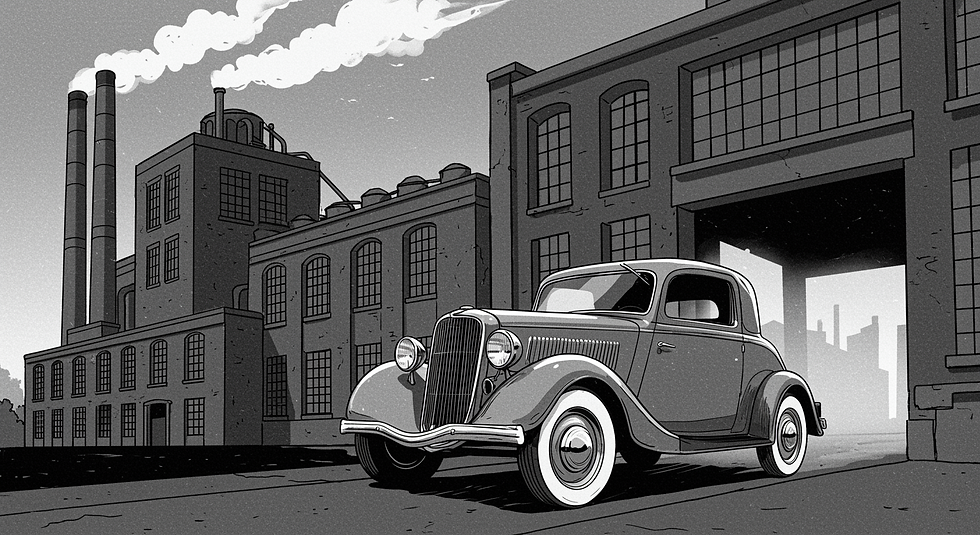
By 1921, automotive design saw a shift toward more refined and streamlined styling, moving away from the purely functional boxy shapes of earlier models. By 1922, balloon tyres—larger, lower-pressure tyres—became widespread, improving comfort and road grip, while bumper bars started appearing as a standard feature to enhance vehicle safety.
During this period, automotive designers sought to innovate by creating distinctive shapes for various major components, but these designs were often developed independently rather than as part of a unified aesthetic. This resulted in a mix of individualized elements—such as headlights, grilles, and body panels—without a cohesive overall form.

1924, automobile bodies became lower, improving stability and aerodynamics, but radiators remained tall, leaving under-engine details visible from the front.
1925, a large percentage of cars featured fixed roofs, marking a shift away from open-top designs for greater comfort and weather protection.
1926, spare wheels were commonly mounted vertically at the rear or side, refining storage solutions and accessibility.
1927, the curving roofline became increasingly popular, moving away from the boxier shapes of earlier designs.
Safety Glass (1927): Ford was the first automaker to use safety glass in its cars, starting with the Model A. This innovation helped reduce injuries from shattered glass in accidents.
1928, wheel designs varied significantly, with wire-spoked wheels being the most widely adopted, while some manufacturers preferred disc wheels or wooden-spoked wheels, reflecting different priorities in styling and engineering.
1929, automobile body construction incorporated a variety of materials, including steel, wood, and fabric, often combined to balance strength, weight, and cost-efficiency. This approach allowed manufacturers to experiment with durability, comfort, and design, influencing the structural advancements of future automotive engineering.

Early car heaters were introduced as optional extras in the 1920s and 1930s, with Ford offering a heater in the Model A (1929). By the 1950s, most American cars included heaters as standard equipment, improving comfort in colder climates.